
The Bangladesh Telecommunication Regulatory Commission (BTRC) has prepared a 2G sunset plan to switch off 2G mobile services by December 2029. More than six crore feature phone users will be asked to move to 4G phones, and affordable smartphones sit at the centre of the plan. Here is what the 2G sunset plan includes and how it could affect you.
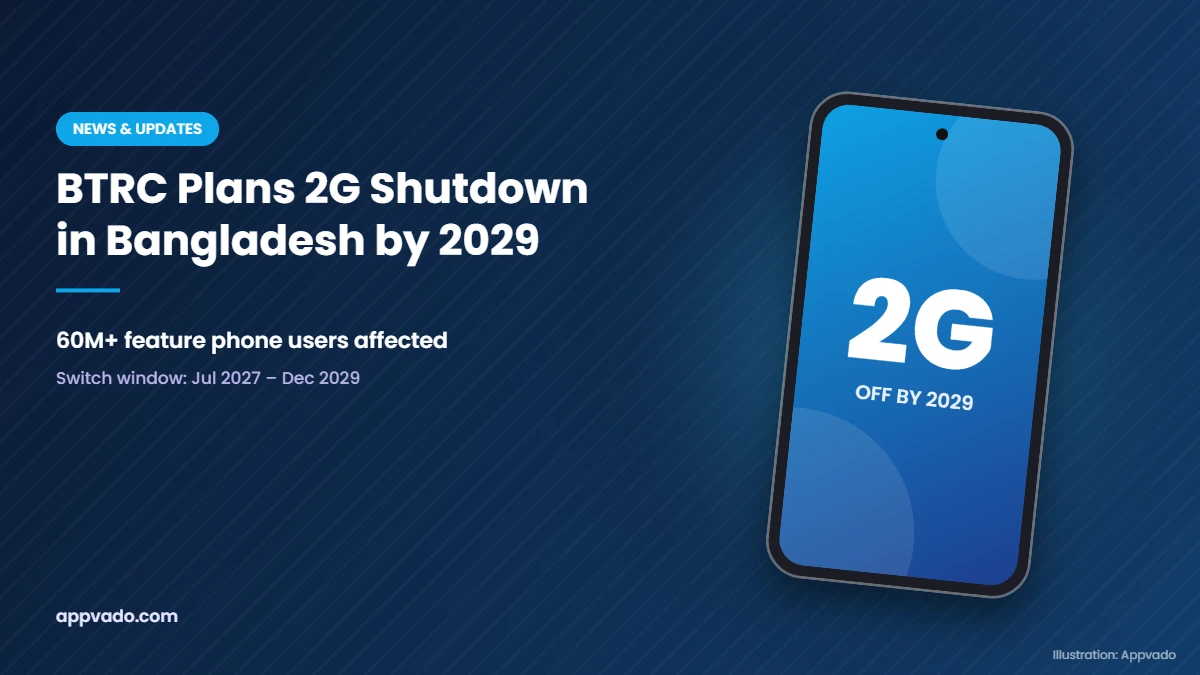
Table of Contents
What the BTRC 2G Sunset Plan Says
- 2G services will be phased out by December 31, 2029.
- Feature phone users will have from July 1, 2027 to December 31, 2029 to switch to newer devices.
- New ODM licences for 2G handsets end on December 31, 2026, and the last marketing approval for locally made 2G handsets is June 30, 2027.
- Imported 2G IoT and M2M equipment must move to 4G or VoLTE by June 30, 2028.
- The freed 2G spectrum will be reused for 4G, 5G, LTE-M and NB-IoT networks.
The roadmap was approved at the BTRC’s latest commission meeting and will now go to the Posts and Telecommunications Division for government approval. A June 2026 workshop with operators, manufacturers and importers looked at three possible deadlines, 2029, 2030 and 2032, before settling on the end of 2029.
Why Bangladesh Wants to Shut Down 2G
2G networks only handle calls and basic SMS, and they take up valuable spectrum that could carry faster 4G and 5G data. Moving users to 4G gives them access to mobile internet, digital payments and government services. The adviser for posts and ICT has said the goal is to bring roughly seven crore people who still lack mobile data into the digital economy.
How Big Is the 2G Market Today?
Feature phones still dominate local production. Bangladesh factories built about 3.28 crore handsets in 2025, and nearly 65 per cent were 2G feature phones. In January to August 2026, around 66 per cent of the 1.82 crore phones produced were still 2G models. Local makers say demand for feature phones is above 10 lakh units a month.
| Period | Total handsets made | Smartphones | 2G feature phones |
|---|---|---|---|
| 2025 | 3.28 crore | 34.87% | 64.69% |
| Jan–Aug 2026 | 1.82 crore | 33.27% | 66.23% |
Cheaper Smartphones and Subsidies
The plan leans heavily on making smartphones affordable. Proposed support includes government-branded subsidised smartphones, tax-free VoLTE feature phones, VAT-free instalment plans, device subsidies from the Social Obligation Fund for low-income users, and handset financing by mobile operators. The government has talked about bringing the effective cost of a basic smartphone down to Tk2,000 to Tk3,000, and manufacturers have reportedly offered to subsidise up to Tk1,000 per device.
Industry Concerns
Not everyone is happy. The Mobile Phone Industry Owners’ Association of Bangladesh (MOIB) wants the decision reviewed, warning that if legal 2G production stops while demand remains, buyers may turn to the grey market and local factories could be forced to cut jobs. Workshop participants also flagged risks such as lost connectivity for 2G-only devices, emergency communication gaps and higher support costs for operators.
What It Means for You
If you use a basic 2G phone, nothing changes today. You have until the end of 2029, and the switch window only opens in July 2027. When you next replace your phone, a 4G VoLTE feature phone or an affordable smartphone is the safer choice. Budget options such as the vivo Y04 show how far entry-level smartphones have come. You can follow official updates on the BTRC website.
FAQ
When will 2G shut down in Bangladesh?
Under the BTRC 2G sunset plan, 2G services are set to end by December 31, 2029, subject to government approval.
Will my feature phone stop working immediately?
No. Users have until the end of 2029, with the transition window opening on July 1, 2027.
Will smartphones get cheaper?
The plan proposes subsidies, VAT-free instalments and operator financing to lower smartphone costs, but details are not final yet.